

 Login
Login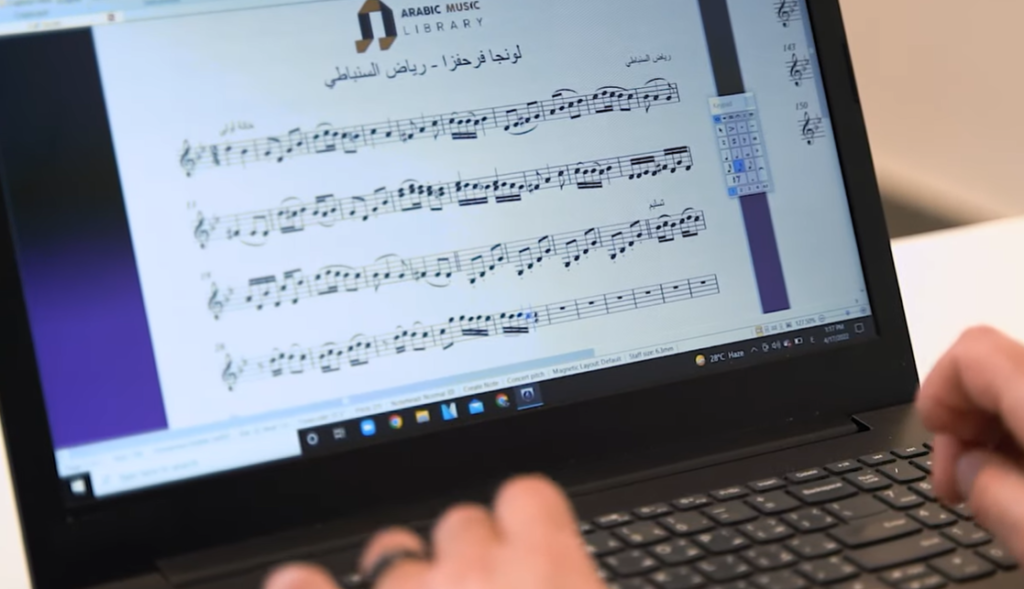
Can Every Musician Transcribe Music? Why Notation Is One of the Most Professional Skills in Music
Many people assume that anyone who can play an instrument can also write down musical notation. In reality, it’s quite different. Musical transcription is one of the most specialized skills in music, combining trained musical hearing, theoretical knowledge, and hands-on experience.
What Is Musical Transcription?
Musical transcription is the process of turning what is heard into written notation, so that another musician can perform the work with essentially the same detail. This process typically involves capturing:
- The melody.
- The rhythm.
- The maqam (mode).
- The meter.
- Musical expression.
- Dynamics.
- Performance markings.
- Voicing/arrangement, when needed.
Do All Musicians Have This Skill?
Simply put: no.
Many musicians are highly skilled performers or singers, yet they don’t necessarily have the ability to accurately transcribe what they hear. That’s because transcription relies on a set of specialized skills that a musician doesn’t automatically acquire just by mastering an instrument.
What Skills Does a Music Transcriber Need?
To become a professional music transcriber, someone typically needs:
- Highly trained musical hearing, able to distinguish pitches precisely.
- Deep knowledge of Arabic maqamat and their modulations.
- An understanding of Arabic rhythms in their many forms.
- The ability to distinguish different instruments within a recording.
- Knowledge of the rules of musical notation.
- Proficiency with notation software such as Sibelius, Dorico, or Finale.
- Patience and precision — transcribing a single minute of music can take hours of work.
Why Is Transcribing Arabic Music More Difficult?
Arabic music has features that make transcription more complex than in many other musical traditions, including:
- The use of quarter-tones, which standard Western notation doesn’t directly include (they’re typically written using special symbols such as half-flats and half-sharps, within a system that divides the octave into roughly 24 equal steps).
- Extensive ornamentation.
- Improvisation in certain passages (such as taqasim and layali).
- Modulation between maqamat during performance.
- The wide variety of Arabic rhythmic patterns.
Because of this, professionally transcribing an Arabic musical work requires extensive experience and a deep understanding of this musical tradition’s specific character — not just general proficiency in Western musical writing.
Can AI Handle This Task?
Despite major advances in AI technology, most music transcription and generation tools are still built primarily around Western tuning (12 notes per octave), and genuinely struggle to produce accurate notation for Arabic music — largely because of quarter-tones, maqamat, ornamentation, and rhythmic shifts. Even tools that attempt to emulate an Arabic sound usually need careful prompting (specifying a maqam name, or explicitly asking for “quarter-tone” intervals) to get closer to the desired result — and that still doesn’t amount to accurate, professional-grade transcription. Human review and musical expertise therefore remain essential for reliable, professional results.
Why Does Professional Transcription Matter?
Accurate notation saves musicians time and effort, helps them learn and perform with confidence, and helps ensure a musical work reaches future generations without losing much of its detail or being distorted.
This is why musical transcription has become one of the most important tools for preserving Arabic musical heritage today — a bridge connecting original compositions with musicians around the world.
Musical notes are the language through which musicians express their ideas and emotions through sound. They are the primary means that enable musicians to write down musical compositions in a way that allows them to be accurately reproduced, and they are the tool that ensures musical works are passed down through generations.
What Are Musical Notes?
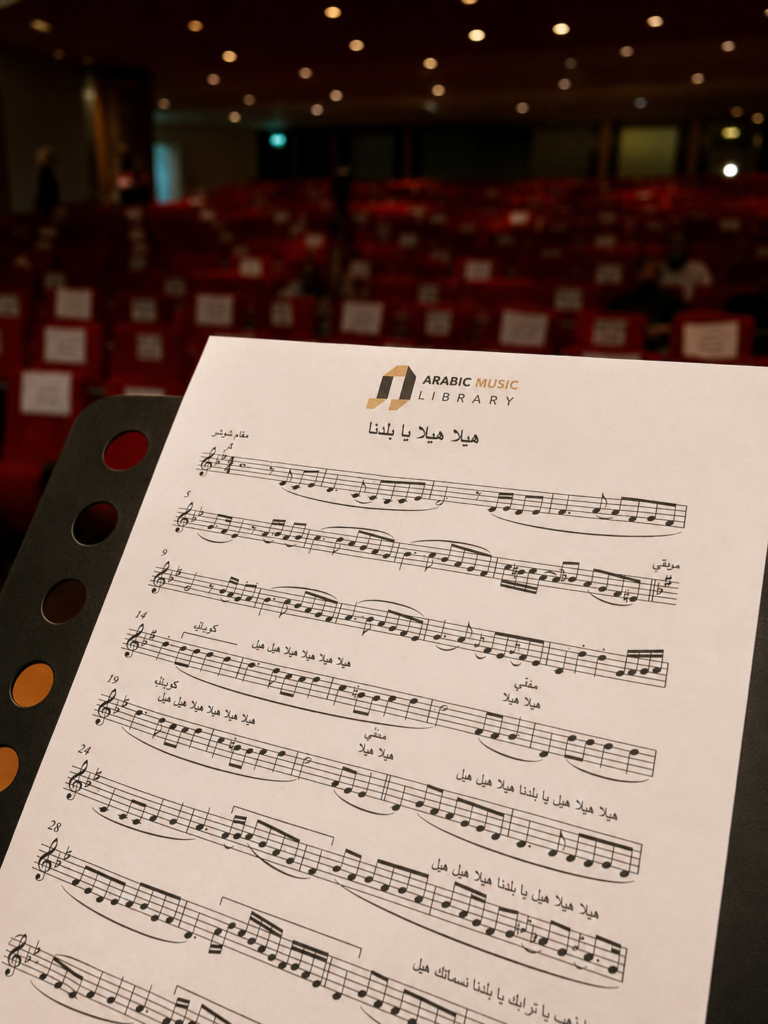
Musical notes are written symbols that represent different musical sounds. Each note has a specific time value that determines how long the sound lasts, as well as a pitch that determines how high or low the tone is. Through these symbols, musicians can understand how to perform a musical piece, including the melodies, rhythms, and dynamic expressions.
The Basics:
Musical notes are written on lines called the “musical staff,” which consists of five lines and four spaces. Notes are placed on these lines and spaces to determine the specific pitch. The shape of the note indicates its duration; there are whole notes, half notes, quarter notes, and so on. In addition, there are other markings such as rhythm and tempo indications that guide the performer on how to accurately execute the musical piece.
History and Development of Musical Notes:
Musical notation has evolved over time. In the beginning, it consisted of simple symbols used during the Middle Ages to record religious melodies. Over time, it developed to include more details, allowing musicians to write more complex music. This evolution played a major role in the flourishing of classical music in Europe during the Renaissance and Baroque periods.
The Importance of Musical Notes:
Musical notes play a vital role in music education. They provide musicians with a way to understand and analyze musical pieces, enhancing their ability to perform and interpret them. In addition, musical notation helps preserve and transmit musical works, ensuring their survival over time.
Musical Notes and Modern Music:
Even in today’s digital age, musical notes still retain their importance. Advanced computer programs use musical notation to write and edit music. Musical notes also remain essential in academic music, where they are used in analyzing and teaching both classical and contemporary musical works.
Musical notes are the fundamental foundation of written music. Through them, musicians across generations can document their creativity and communicate with new generations of musicians and listeners. In the world of music, notes are the universal language that brings together everyone who wishes to express their feelings and ideas through sound.